
NIST AI Risk Management Framework: A Complete Guide to AI Governance, Risk, and Compliance
In today’s world Artificial Intelligence is being utilized by businesses and organisations to carry out critical functions and require significant attention as they have been shown to have an enormous impact on operations and decision making by influencing the lives of employees and customers, as well as impacting public safety.
The NIST AI Risk Management Framework Companies often develop AI systems much quicker than they do an understanding of the risks associated with such systems. ALthough the risks associated with AL, such as bias; lack of transparency; security weaknesses; regulatory risk; and damage to an organisation's public image, are considered 'hypothetical' risks, in fact they have become actual business risks that organisations face.
The NIST AI RMF provides a systematic approach to AI risk management and can provide organisations with a practical framework for managing AI risk, including:
- Understanding and identifying AI risk
- Assessing AI risk
- Managing AI risk responsibly
- Preventing and controlling AI errors before they create a legal or financial problems for an organisation
If you are an organisation that produces or provides AI systems, even if your AI systems only have an effect on customer decision making, it is important that your organisation maintains proper compliance with the guidelines and requirements of the NIST AI RMF as failing to adhere to these guidelines is not a demonstration of innovation, but rather it is an indication of negligence by an organisation.

What is the NIST AI Risk Management Framework? (AI RMF)
NIST's AI RMF is a freely available framework for organizations that want to create their own methodologies for addressing AI-related risks. Its fundamental objective is to establish trust in AI systems by improving their security, openness, fairness, and accountability. Unlike existing cybersecurity frameworks that focus primarily on the technical aspects of AI, the NIST AI RMF also encompasses:
- Ethical concerns,
- Operational concerns,
- Legal concerns,
- Societal impacts, and
- Governance failures
As a comprehensive approach to managing AI governance and risk framework that includes more than just technology, the framework provides a holistic and adaptable way to manage
the risks associated with AI. The NIST AI RMF has been created in a manner that it:
- is not technology-specific
- is not industry-specific
- can be implemented by start-ups, small businesses, large corporations, and government agencies, and
- is compatible with the regulatory structures of nations around the world.
The NIST AI RMF does not specify which AIs should be developed, and it provides a guidance framework for developing AI responsibly.

Why Does NIST AI RMF Matter for AI Governance in Current Environment At Present
All companies profess to be responsible with their use of Artificial Intelligence; however, very few can substantiate their claims regarding being responsible with AI.
Without substantive frameworks available to AI organizations, AI governance becomes reactionary to risk, documentation theatre for governance, and compliance is something that is executed in a panic upon receipt of a notification from a regulatory body to an organization.
NIST provides a framework within which organizations perform their own AI governance, rather than having to take the word of the organization as to what their stated intent is.
The NIST AI RMF Framework Forces Organizations to:
- Establish Ownership for Risk Associated with AI
- Establish Ownership for Risk Associated with AI
- Document Risk Exposure
- Create an Accountability Chain for Decision Making Processes
- What clients, partners, regulators and their own employees expect today.
If an organization’s AI system causes any type of harm and they cannot provide a risk assessment, controls and governance structure to verify that:
No X, bad situation or a major issue on hand – No defence. Work on providing evidence to establish defence.
How NIST AI RMF as a part of an AI Governance and Management Framework on Risk
How NIST AI RMF as a part of an AI Governance and Management Framework on Risk
Strategy→Governance→Risk Management →Compliance
The NIST AI RMF would be in the middle of these four categories, linking the following:
Business goals, Legal requirements, Technical Controls, and Ethical Standards.
An effective framework for AI Governance and Management of Risk defines the following using the NIST AI RMF:
Accountability - Risk Tolerance - Policy Development - Enforcement of Responsible AI Development
Without this framework, Governance will be superficial, and Risk Management will be left to chance.
Traditional Risk Models vs. AI Risk Management
Traditional risk management focuses on:
- Financial Risks
- Cybersecurity Risks
- Operational Risks
With the introduction of the new paradigm of AI and Deep Learning, there are now additional types of risk associated with these technologies.
These include:
- Algorithmic Bias
- Misuse of Data
- Lack of Explainability
- Model Drift
- Automation Overreach
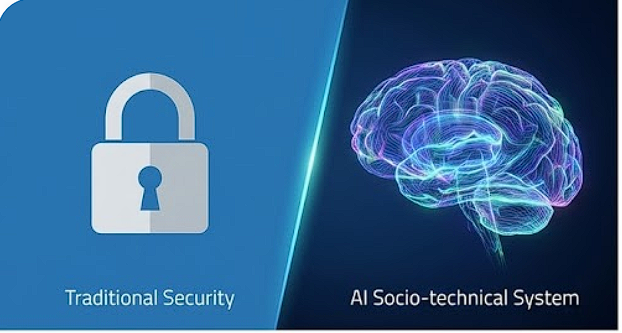
This is the reason that the NIST AI RMF takes a different approach. Rather than treating AI as a form of software, it views AI as part of a larger socio-technical system.
Furthermore, the NIST AI RMF recognizes that the risk associated with AI is not purely a function of technical failure, but rather it is also a governance failure.

Core Structure of the NIST AI Risk Management Framework
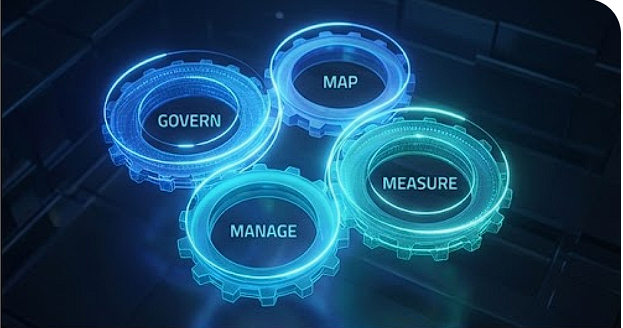
The NIST AI RMF includes four critical operational functions - govern, map, measure and manage. Understanding these functions is crucial to understanding the entire NIST AI RMF, as everything else in the NIST AI RMF adds on to and around these four functions. The four functions are not linear or sequential, but rather they represent continuous controls that must be monitored at all times. If any of these four operational functions are weak or ineffective, then the entire NIST AI Risk Management Framework will fail.

Ensure the proper Governing of AI to Create the Foundation for Risk Management
A company’s initial focus on tools is the opposite of what it should be. The NIST AI Risk Management Framework begins with the Governance aspect of a company because without Governance, Policies and Accountability, there is no actual Risk Management.
The Govern function provides:
- Accountability for AI Risk;
- Ability to approve the Implementing of AI; and
- A framework for responding to AI failures.
- If your AI Governance cannot answer each of these questions with one brief statement, you do not have any AI Governance.
The NIST AI RMF is a Governance and Risk Management Framework because it requires that the organizations’ leadership takes ownership for their organization’s AI development process rather than placing the responsibility entirely on Engineers.
Govern includes:
Creation and Implementation of AI Policy and Standards; and Develop an AI Risk Ownership Structure and Internal Control.
Documentation can contain both the requirements and examples of documented evidence that will demonstrate the organization’s ongoing Regulatory Awareness regarding AI Technology.
With no Governance there will be no Compliance, Accountability, or Credibility.

Mapping Your AI Risks Before They Affect You
The Map feature allows you to find out where your Risks exist, and understand how your new AIs are performing. It forces you to record all of the following:
- The purpose for which you created your AI system
- The sources of the data that you're collecting and using
- The stakeholders who will be impacted by your AI systems
- The potential harms caused by your AI systems
- The operational context in which your system will operate
Mapping reveals the following risks associated with AIs:
- Bias in AIs
- Integrity issues with Data
- How AIs can be misused
- Hidden dependency on the AI
Most teams are overwhelmed with the realization that they have created an AI without fully understanding its potential consequences. Through Mapping, the AI becomes concrete and measurable, whereas before it was just an abstract idea. This is essential for complying with the NIST AI RMF standard.

Measuring Risk and Taking Control
You can’t manage risk without measurable data.
Measuring function measures:
- Metrics
- Ways to evaluate
- Ways to test
- Risk scoring methods
Metrics include:
- Accuracy testing
- Bias detection/testing
- Robustness testing/evaluation
- Security checks for vulnerabilities
- Explainability testing
Measuring will tell you:
- What is the risk associated with using an AI product? (look to measuring)
- Is risk level increasing or decreasing over time (look to measuring)
- Are the controls in place working effectively to reduce risk associated with using AI products (look to measuring)
The measure of risk will drive any real risk management framework for AI.
Without Metrics, there is no Evidence.
Without Evidence, there is no Compliance.

Control–Managing Risk Instead of Just Describing It
In the Control function, control of the risk becomes a reality.
It involves:
- Actions to mitigate risk
- Updating models to control the risk
- Changing processes to control the risk
- Restricting deployments due to the risks
- Planning for incidents related to controlling the risk
Managing will help to determine:
- If the risk is beyond acceptable limits, then what to do?
- How quickly can we act in response to the risk?
- How quickly can we act in response to the risk?
- Control is where many organizations fail.
They identify the risks, but they do not take steps to enforce a risk control strategy.
The NIST AI RMF is very clear:
When you identify risks and do not take steps to control those risks, it is deemed to be negligence.

A complete AI risk management framework is formed by the combination of these four functions:
Govern – Sets rules.
Map – Finds risks.
Measure – Quantifies risks.
Manage – Controls risks.
The close-loop structure of this function combination is used to manage risks continually via an iterative process.
This is why the NIST AI Risk Management Framework is not theoretical but rather has an operational purpose.
In doing so, AI Governance:
- Transforms into a living system
- Provides a means to measure AI Governance.
- Creates a defensible conception/compliance structure.

Our Approach to Implementing NIST AI RMF
This will turn your NIST AI RMF into an operating system.
AI Risk Assessment - Identify NIST AI RMF guidelines that are not met by your organization
AI Governance - Establish policies, accountability, and responsibilities for AI governance.
AI Risk Map & Measurement - Identify, quantify, and categorize model, data, and bias risks.
AI Risk Control & Monitoring Plan - Develop plans for mitigating identified risks and provide ongoing monitoring of risks.
The result is a working AI Risk Management Framework rather than just a report.

Why Do Companies Choose Us for NIST AI RMF Compliance?
The majority of "consultants" explain what the NIST AI RMF is, and how to comply with it; we actually create implementations.
The advantages of working with us include:
- More rapid compliance-readiness.
- A practical AI governance model.
- Less risk from regulatory enforcement.
- Document ready for audit.
- Increased client confidence.
This is true deployment of AI governance and risk frameworks; not just consulting theater.

Applying for the NIST RMF (Risk Management Framework) for AI (Artificial Intelligence) is Mandatory for:
- AI Start-Ups Preparing To Provide Services to Enterprise Clients
- SaaS Providers That Use AI Models
- Fintech and Health-Tech Platforms
- Enterprises that are Scaling Up Their GenAI (Generative AI) Use Cases
- Companies that are Operating In Regulated Industries
If Your Products Contain An AI Component, Then The NIST RMF Has The Ability To Provide Protection Against The Risks Associated With AI.

How The NIST RMF Creating Business Value
The NIST RMF Benefits You By:
- • Establishing Enterprise Contracts
- • Passing Vendor Risk Assessments
- • Reducing Compliance Costs
- • Establishing Yourself As A Credible ""Responsible AI Provider"" To Your Clients And Potential Clients
- • Protecting Yourself From Future Legal Liability
That's Why Serious Companies Are Investing Early In The NIST RMF.

Modern AI Governance is established by the NIST Risk Management Framework that guides Companies in how to build Trust, Manage AI Risk and Stay Compliant with Standards Set by NIST.
When an Organization has successfully Implemented:
- NIST AI RMF Guidelines
- A Solid AI Risk Management Framework
- Implementing the Policies that Support the NIST AI RMF
- An Organized AI Governance and Risk Framework
- AI becomes a Business Asset
The NIST AI RMF Framework will be your Shield, whether you Sell/Use AI or Provide Services that Incorporate AI.
Ready to make your AI compliant, defensible, and enterprise-ready?
Book a NIST AI RMF assessment call today and get a clear roadmap for AI governance, risk control, and compliance implementation.



.png)